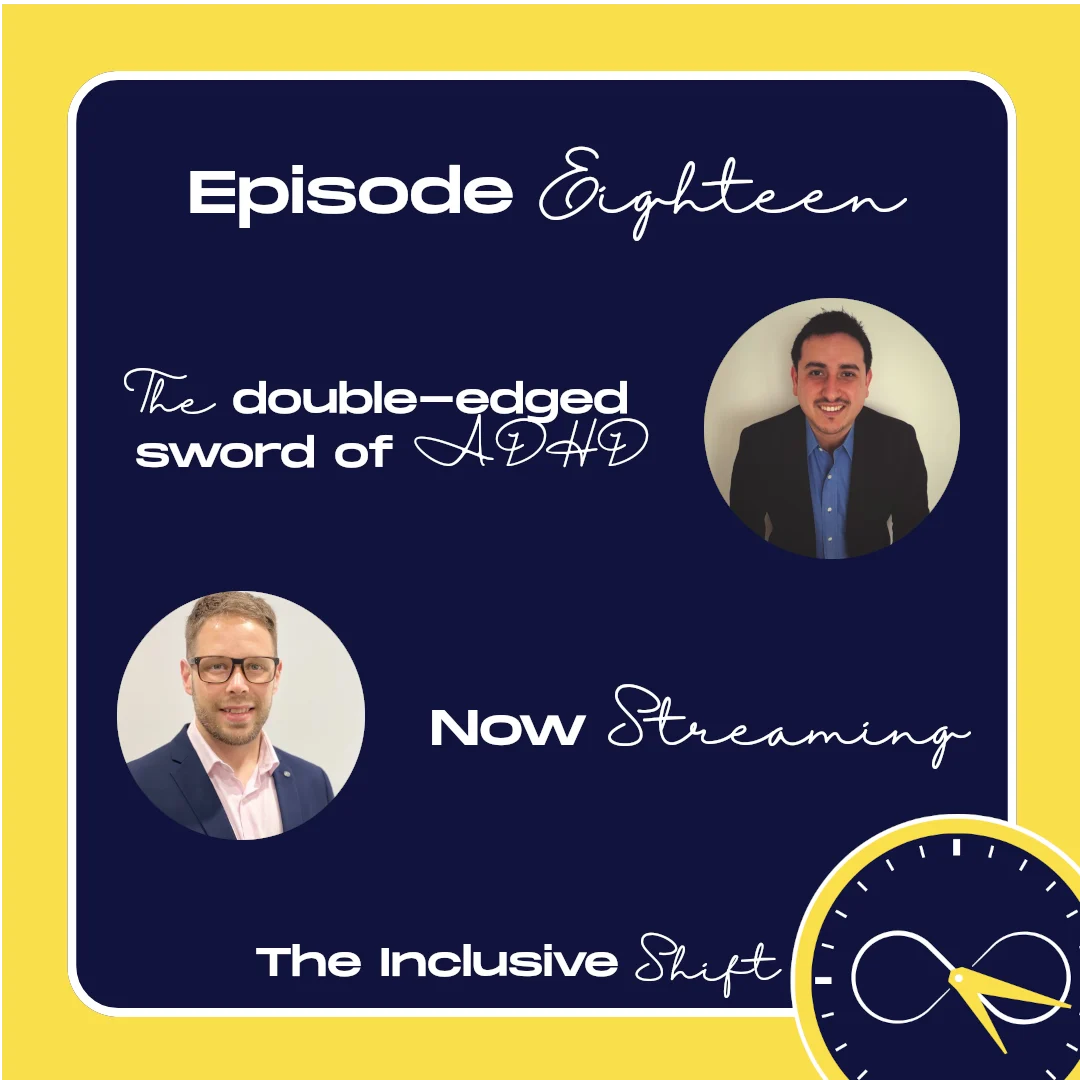

About this episode
Jorge Santibañez, a solution architect diagnosed with ADHD as a child in Chile, joins Nic to explore his neurodiversity. He shares his passion for indoor skydiving, leveraging hyperfocus with AI agents, overcoming corporate mistakes at Dell, and applying self-compassion in work and parenting.
Resources mentioned
- ARTICLE20 Gratitude Exercises & Activities to Boost Well-BeingPopular gratitude exercises include keeping a gratitude journal, writing gratitude letters, using a gratitude jar, and practicing gratitude.
- BOOKHyperfocus by Chris BaileyPublished in August 2018, the book argues that managing your attention—rather than your time—is the true path to efficiency, creativity, and a meaningful life.
- BOOKLimitless Expanded Edition: Upgrade Your Brain, Learn Anything Faster, and Unlock Your Exceptional LifeA definitive guide to meta-learning (learning how to learn). Written by a world-renowned brain coach who overcame a childhood traumatic brain injury, the book outlines a framework for dismantling self-imposed limitations and optimising cognitive performance.
- RESEARCHSelf-Compassion: Theory, Method, Research, and InterventionDr. Kristin Neff’s framework for self-compassion defines it as treating oneself with the same warmth, care, and understanding that you would offer a good friend during moments of suffering, failure, or personal inadequacy.
Transcript
Nic (00:01.974)
Welcome to the Inclusive Shift, the podcast where we explore what it really takes to build workplaces that embrace neurodiversity. I'm Nic Nagtzaam and in each episode, I sit down with neurodivergent professionals, leaders and experts to hear their stories, challenges and insights on creating inclusive workplaces. Today on the Inclusive Shift, I'm joined by Jorge Santi-Bañez. Jorge is a solution architect, a father of a young daughter.
Continues for 1 hr 9 min — read the full transcript
and someone who describes his ADHD as a double-edged sword. Something that can be a unique capability or an incredibly difficult depending on the environment. Alongside his work in technology, he's also passionate about indoor skydiving, a space like many others in his life that brings together focus, energy, and intensity. Today we explore what it means to live and work with ADHD when much of it
when much of the experience grows unseen. Jorge welcome to the Inclusive Shift.
Jorge (01:03.566)
Thank you, Nic. Thanks for having me and beautiful work that you do. So I love to be part of it.
Nic (01:09.015)
No. absolute pleasure. Okay, before we jump into all of your ADHD, I'd love to learn a little bit more about you and outside of work and what drew you to indoor skydiving.
Jorge (01:26.51)
Look, I tried indoor skydiving probably. I've always super since I was a kid, I was always finding, I was getting bored easily probably because of the ADHD. And I couldn't really feel like happiness sometimes. I was like, yeah, like I was getting really bored.
In a trip to the US in 2010, I checked one of these indoor skydiving because I really wanted to do skydiving, the real one, but I'm scared of heights, so I never really was going to try. I might try one day, but I was like, I'm going to give it a go.
The first time that I did it, I really felt happiness. Like I really feel like when I jumped, I was just waiting my turn and I jumped and I was like flying. And I remember I was like smiling and I was like, my God, this feels so, I feel happy. And I was like, I remember I even like had a little tear, like it went away probably. But, but I felt so happy in that moment. Then I was like, my God, this is what it feels.
happiness and I was of course my first time, I wasn't doing anything wrong, I was all over the places and the instructor was helping me but that was my first...
My first reaction, I thought, look, this is actually, we're in a time in the history that we're probably 100 years ago, nobody was gonna be able to do this because technology and everything, so we're so lucky to have it. that's what drove me to start doing it. Then I started to do it more often. I was back in Chile.
Jorge (03:29.45)
So we didn't really have indoor skydiving in Chile, but when I moved to Australia 10 years ago, we have just one 15 minutes from my place in Melbourne. So I started doing it more often and I love it. love it. It's just give me so much focus on whatever single thing that you move in your body, it impacts how you're flying. So when you're
back flying or when you're doing, I don't know, transitions, it's air, so much coordination and it's so, it's such a slight movement can impact on how you're flying. So yeah, I mean, still doing it. I'm not an expert. If you've done it, probably you can see some of the good guys like moving around and like flying. So I'm planning to do that one day, but yeah, that's what's...
it's keeping me alive.
Nic (04:31.796)
that's awesome. I have tried it once down in Essendon and look, it was fantastic. I've also jumped out of a plane. I'm also scared of heights, absolutely terrified and went, hey, I want to try skydiving. So I went and did the tandem skydiving down in Torquay and loved that so much that I signed up and went and did a solo jump in Bridgewater. And look, you train for an entire day on the ground.
on everything that could go wrong and everything that you need to do to prepare yourself to jump out of that plane. And they're like, you know, everyone's like, why would you jump out of a perfectly good plane? And then you look at the plane, it's like, well, there's duct tape on the windows and you really just want to get out of it as quickly as it possibly can.
Jorge (05:17.774)
Yeah, I think that's my, my, I think if I delete the whole process of jumping into the plane, flying and getting into the actual point when you jump, that whole process is that the one that scares the most. Because if I'm there and I jump, yeah, that's like in a roller coaster, you know, when I'm in a roller coaster, I just, I close my eyes when I'm going up and when I just at the top.
I just opened it up and, yeah, my God. But that's the whole process, I guess. But yeah.
Nic (05:51.75)
No, absolutely. No, it's, it's definitely, yeah, that kind of that anxious moment as you're, building up to the moment before you jump. But as soon as you jump, you get that, release of adrenaline and dopamine. It's like, this is amazing. I want to keep going. So then
Jorge (06:11.734)
Yeah, exactly.
Nic (06:17.026)
Do you notice a connection between the sense of focus or intensity and how your ADHD shows up when you're doing your indoor skydiving?
Jorge (06:28.778)
Yeah, think, look, this is probably something that took me some time to understand about ADHD because some of the questions were, well, where does my personality ends and when ADHD starts, right? Because it might be some overlaps at one point, but I was like, well, is this part of my personality or this is...
part of the ADHD. So it took me some time to read and understand what are the things that an ADHD brain does and how it behaves. And what I noticed was that being more conscious of my body and focus on my body helped me to be more present in the present moment. I'm a super anxious person.
And I was, I've been declining heavily based on all of the diets and keto diet that I've been doing and a lot of meditation that has reduced significantly on how I feel around anxiety. But what helps me to be more grounded and present it is doing indoor skydiving.
or doing things that I love, doing things what I like. So that's kind of what I feel on that angle.
Nic (08:04.217)
Thank you for sharing. I'd love to take a step back and understand a little bit more about how you were diagnosed. Was it early? Was it late? And what's come of that since then?
Jorge (08:15.938)
Yeah, it was when I was probably five years old. Really, I was not sitting quietly. I was moving my legs when I was, everyone was just doing some test or they were in class and I was just moving my legs and just, I wanted to do something. I wanted to jump around and teachers were like, yeah, just stay quiet, you know? And in Chile,
At that time they were not well developed as well. This is probably 30 years ago. So my mom and my dad, took me to the doctor and they said, yeah, you have a PhD, of course. They started with Ritalin and that was probably when I was seven. well, teachers noticed right away they noticed that I was on some sort of medicine because I started with good grades and...
But I really...
I didn't really want to keep taking that medicine because it was a lot of money for my mom and I was conscious that they were divorced with my dad and I didn't want to bring that significant expense to my mom. And the other one was my hands were sweating and I felt, I don't know why I was like always sweating. This is like after being like around two, three years with Ritalin.
And I said to my mom, look, I don't really wanna keep taking it. And she said, yeah, look, it's up to you. And I stopped it. And of course my degrees as well went low and that was a trade off. But I decided to do that at that age. But I always noticed that...
Jorge (10:07.182)
it was something else in that because I was super social. was always like surrounded by people and like they're always were trying to make me.
I can know the president of our class. They were always like, and I was just trying to have fun. I was like, I feel like I was always trying to find that sort of momentum or keeping that high energy. And everyone was like, Jorge is so funny. Jorge is so like active and he wants to do so many things and he's so creative and we don't get bored around Jorge, right?
But of course when I was with Ritalin I was just, you know, like a boring whore I guess.
Nic (10:58.892)
So then you, I mean, you've described your ADHD as a double-edged sword. I'd love to kind of unpack what that means to you.
Jorge (11:03.406)
Hmm.
Jorge (11:08.286)
Yeah, and it is.
Jorge (11:15.27)
I think it is like a knife, right? You can use a knife to make a nice meal, a nice sandwich, but you can also harm people with it. And I feel like, for example, with ADHD, is... So for me...
I'm super creative when I have ideas, right? And I've seen this in the past, especially for people that are entrepreneurs or socially like with ADHD. I start with an idea and then I want to do something else and then I want to do something else and then something else, something else, something else, right? But I never get something done because I'm changing or jumping from one place to another.
While what I started to do now, and actually I started this like probably three months ago, I just said, you know, I'm just gonna close everything. I had businesses, had like side hustles, I was doing some other things and I said, you know what, I'm gonna close everything. I'm just gonna do one thing and I'm gonna do it right. So what is like a trunk of a tree, right?
but I don't have to have do different things. Like I don't have to create different trees and trunks. I just have to have a single trunk and then branches. Like I can use that creativity for creating with a baseline instead of creating multiple baseline and then get a...
diverge and basically don't do anything. So I feel like it's a double-edged sword because if you don't know how to focus or control or having a focus, you can easily get distracted. And you can be really creative. You can come up with a lot of cool and creative things, but the problem is that...
Jorge (13:21.422)
you're not gonna achieve anything because you're just finding the next thing that is gonna produce that dopamine or that excitement that you're trying to look for. But what I learned is, well, if I just keep focusing on this, I'm gonna find that excitement in another little branch that I can create something, a really beautiful tree, for example, right? And that happens like with a lot of things. So that creativity.
I feel like sometimes it's that double-edged sword.
Nic (13:56.423)
So then, with that double-edged sword, when does it feel like a strength and when does it feel like... Sorry. So with that double-edged sword, when it feels like a strength, what does it look like for you with your work and your life?
Jorge (14:14.894)
Like thinking outside of the box because sometimes that creativity brings some unconventional solutions that people never thought about because you're not... It's talking one single problem, like just trying to fix a problem and saying, oh yeah, we should actually do this and this and this and I'm like sometimes it's like, oh, what are we...
Why actually this problem exists? mean this problem shouldn't even exist. So it allows me to to be more creative and step back and think outside of the box and say We're actually spending our time in the wrong barking to the wrong tree, you know, like it's that those are some of the strengths that I I Felt sometimes in my career had helped me in that regard in problem solving
But also in relationships, right? I I tend to To and this is probably I don't know how much you know about the ADHD brain probably, you know, but whatever what I've Read and what I've been studying is that you basically it's really hard for you to switch the external
a stimulus, right? From your senses, Sensitivity, know, what you see, what you hear. And like, that's why I hate going to the mall, right? If I go to the shopping center, I'm always hearing that background noise. And when I go out, I...
I feel really tired, right? I feel like, my God, that was exhausting because my brain is always hearing that even though my wife is talking and I have to listen to what she's saying to me, but I'm also hearing in the background. So it's so drained. I finished up that whole experience of being in a shopping center, completely drained. So.
Jorge (16:28.32)
What happens for me it is, well,
Once I have that, and probably that's my indigibrium, sorry, from some side, I tend to jump from one place to another as well, right? That's what helps me to build relationship with people, right? Because especially what I'm doing now, right? I've been studying and it's called like threads conversation. Sometimes I can just have a conversation with someone just by...
letting my brain flow, you know, oh no, I'm doing this and that and people are like, oh yeah, actually I, I, I, do this as well. And then I started having some conversation with some people because I just let my brain talk and you know, I started talking and that's what's helped me to in my career as well, helped me, helped me to build a strong relationship with customers, build a strong relationship with technical people that they were like really sometimes.
in introvert and I was extrovert and sometimes I was like, yeah, but what do do? And I'm actually curious about the individual and also what I was saying around those impulses, I mean, being extra aware of noises and feelings and I can really see micro expressions.
You know, for example, I can really notice when someone is getting bored, when someone wants to change topics, when someone wants to,
Jorge (18:08.002)
Talks about something else, you I can just sometimes keep the momentum up because I notice when the people is getting excited about the conversation or I notice when the people is getting bored. So I can basically not control the dynamic, but I'm more aware of what's happening with the other people that I'm having that conversation. So that's why sometimes, I don't know, I was really good at.
lunches with customers asking for budget. I think now is the time to ask for a budget. Now is the time to ask for some things that probably that individual wasn't going to share in another sort of dynamic or setup. So yeah, that's what I experienced.
Nic (18:56.64)
It's so good that you have an understanding of what your strengths are and how to best leverage those with your ADHD. I'm very similar when it comes to going to shopping centers or to loud environments, trying to make sure that I can focus on what's important, be it the kids and what they're talking about or my wife.
and trying to block out everything else, but it's extremely challenging and you're right, you come home and you're exhausted. So it's a challenge, but it's such a, so good that you have the ability to kind of understand, you know, your best strength is being able to understand someone else and their expressions and whether they're fully engaged in that conversation because, you know, that's the perfect sort of
selling point for you to be at work with external clients or to be able to sell to someone as well, which is awesome. So then when does it feel painful or difficult and how how did those moments kind of come in for you?
Jorge (20:09.694)
yeah, good question. In the same topic, when I noticed...
Jorge (20:20.314)
When I'm able to see micro expressions, I notice that people probably are lying to me or probably they're telling me something that they are not really thinking of. And that's an internal conflict. That's why I, in my corporate life, I really struggle in terms of I hated it because...
Nic (20:26.398)
you
Jorge (20:47.286)
You always have to play the game, even though you know deep inside of you that those are things that are not actually true. So it felt that I needed to change my kind of own identity to fit in a place that I wasn't really, I wasn't really keen to change who I was. So understanding other people's micro-expressions, will say.
It also...
Yeah, it creates an impact on, I don't know if your boss is actually, you notice some kind of also intuition or you notice something about your boss that is making you realize that your boss is not gonna protect you in your work environment. Then you're like, well, I think I'm gonna have to spend now protecting myself. that's sort of energy.
wasted on not actually doing your job, but also spending some energy and work on protecting yourself from your manager that should be actually protecting you from the corporate BS, right? So those are the things that I feel that it was kind of negative because if I'm not aware of that, probably it's just,
Nic (22:07.224)
Mm-hmm.
Jorge (22:18.38)
just a signal of something that I'm gonna probably get impact by in the future without knowing, I would consider negative because influence my emotions and drains my energy. But it also helps me as well to, you know, again, like protecting myself, for example, in those cases.
And also with the wife, you know, and I think those are the... And of course, when I try to keep up with a conversation or I really need to focus on what someone is saying, I might be thinking about what the person said before and I'm still processing that and I'm like, yeah, but actually this is how she's behaving and this is why she's talking. And I lost that track of the conversation because I'm thinking on something else.
So I think that's probably something that as well I feel like painful or hard to deal with sometimes.
Nic (23:23.736)
Yeah, because it then causes you to have to circle back and kind of go, sorry, can you repeat that question? Because you were distracted by other things that were going on either in your own brain, because you've got 100 different sort of trains of thought going on, or by something else that's going on in the room at the same time as well.
Jorge (23:42.56)
Yeah, actually, it's funny. When I came to Australia, it was my first job in a corporate, at Dell, I work at Dell, big corporate, and actually had to go back to Ritalin. I had to go to a psychologist in here in Australia to get Ritalin and I had to bring all the paperwork from Chile because I couldn't, I had to be 100 % present in those meetings that were like,
multi-million dollar RFPs and I was like, my God, everyone's getting it, but I'm not getting it. I was getting so distracted by all the noise of everything, what's happening in that time. was some political things happening. It was so emotional. People like afraid of losing the deal. So, and I was like.
I couldn't really focus on doing the actual work. So had to go back to a psychologist here and say, look, man, give me some Ritalin I really, I need to get, I'm getting, smacked a hammer at work and I need to really get something to focus. And, I would say, and I was doing, I was taking it, when I really needed to focus. but again, I was getting my hands sweaty. and I just said, look, I'm just gonna try to find some.
other methods which is the one that I've been in the last two years.
Nic (25:07.349)
No, that's good to hear. So then you've spent quite a bit of your career as a solutions architect. You're working on complex, big problems and trying to solve those. Where does your ADHD help you the most in that space in your work?
Jorge (25:25.966)
I think, yeah, we, I think we touched a little bit on that. was probably relationships. That's the most, some people probably doesn't realize how, for example, sales reps that doesn't have ADHD because I think a lot of sales reps out there have ADHD, undiagnosed.
Nic (25:32.705)
Yep.
Jorge (25:49.294)
And some people that I work with, couldn't just get signals from customers. I was like, man, actually, is not, that's not, and they were like, no, no, no, yeah, I mean, I'm like, I mean, actually, this is, mean, the reading the room, reading those sort of things, that's what helps me. also relationships and creative thinking. I think when you face some different...
problems and situations, especially when there's money involved and there's some really deep technical things involved, if you're able to just think outside of the box and start saying, I still remember one time in Chile, I made a mistake, rookie mistake. I pressed, it was a...
a solution that I was supposed to get a single engine from a solution. And for some reason, my ADHD I didn't realize that I put like four engines and I was like one engine because this is how we were quoting. Anyway, I found out by the distributor that called me a few months after, he was like, hey man, why you have a huge rack in here in the warehouse? And I was like, what do you mean a rack? was supposed to be an engine.
And I start checking, I was like, my God, made a huge mistake. Huge mistake. I was like, what I'm gonna do? What I'm gonna say to the customer? And I started to think, said, look guys, know, first of all, let's be honest with the customer. I don't really wanna lie. Look, I made a mistake, but the good things for you, and I had a really good relationship with the customer, Good thing for you, it is that you're in this threshold of your workloads.
Your one single engine is gonna give you this growth, right? But you're gonna keep growing the next five years. The good thing for you is that For deal with these four engines, you're gonna have basically No limit, right? So I said to them because they had a little space in their data center So they couldn't afford to put another rack and I said to them look guys We made a mistake we can break it apart what's gonna be costly it was gonna be a mess but
Jorge (28:16.546)
what we can do and send it back. But what we can do is just get this as a gift and you're not gonna have to be worried about this, workloads being increased in the next few years. And they loved it. They were like, thank you for that mistake. So those sort of things are the ones that I felt that just thinking out differently and having a good relationship helped me to be successful in those sort of.
because they had to pay more for that rack space and everything so they actually increased their price. Yeah, those are the things that probably had helped me.
Nic (28:56.988)
That's so good. That's such a good story. Thank you for sharing. Give me two minutes. My kids are screaming and it's distracting me. I just need to ask them to be quiet.
Jorge (29:05.966)
Go, go.
Go for it, go for it.
Nic (29:38.865)
goodness, kids are playing Super Mario Brothers and it's just going crazy in the background. It's like guys, guys you need to be quiet. I can't concentrate.
Jorge (29:44.905)
nice
Jorge (29:53.454)
I also play Mario, Super Mario, Smash Brothers and Kart, so yeah, I'm still a kid sometimes.
Nic (30:00.56)
Me too. It's just distracting. Just gets distracting when I can, all I can hear is them screaming in the background, even though I've got a, a door and a wall of noise cancellation and I can still hear them. It's like, okay, you guys are loud, bring it down.
Jorge (30:01.666)
That's good.
Jorge (30:19.502)
That's Yeah.
Nic (30:23.576)
All right, let's jump back in. All right. So, that was such a great story, you know, and it's such a good example of how you you've taken a mistake and you've, you know, worked with the client to, Leverage, you know, that mistake and make it a benefit for them as well. So then with your ADHD in mind, where are the differences between an
you know, an environment that you're to work really, really well in versus an environment that you really struggle in as well.
Jorge (30:58.484)
Hmm, good question. think probably will be three main.
Jorge (31:08.398)
Three main things that I think will be valuable. I mean that helps me to Flourish and be creative and just add value and the first one is trust. I mean if
If leadership trusts on what I'm doing, I'm focusing on spending all my energy on being creative and solving problems and actually moving the needle on things that actually create value. The second one is focus. So it's not like a hand holding, but it's more like a
Look, I'm aware of your ADHD. Let's make sure we put some guardrails so you actually can focus on what's important and not the signals or stimulus that you're getting that are not relevant. Probably for your brain is relevant, but it's not actually relevant to complete the main goal. And that's...
And new in a new work, probably that's something that is super important because as an ADHD individual, I really want to create impact probably the first week, but that's really hard to achieve in a workplace where you see people that been there for 10 years. So they took the long run. So that creating impact is, it's something that's not going to be overnight. So if you have someone that can.
guide you and having that same energy and having that same motivation and something that is really going to create value, the only person that's going to be able to give you that guidance is your leader or your manager at that time because I guess they've been in that organization for a long time. if
Jorge (33:19.886)
I get distracted. is, it's look man, it's just a quick conversation. Look man, really good idea, but that's another tree. We need to create a branch into this trunk. I love your idea, but let's focus on this and this is what we have to do. Oh yeah, man, sorry. And then I go back. So that's the second thing I believe is it's really important to.
to have and the third one it is honesty. And for me, I know it's really hard to be honest in a corporate world, but at least if my manager is honest with me.
I don't have to spend my energy protecting myself or being having resentment or I don't know. It's just everything flows, you know? So, and I know it's really hard, but as long as my manager is and say, look, man, I think you made a mistake here. We better fix it. And these are the consequences. Oh, thank you, man.
I'm not gonna have to hang around that ambiguity or that...
that sort of uncertainty that just gonna create more anxiety and it's gonna just diverge me from what I'm working on. I think those are the key three things that I feel like it's really important in that regard.
Nic (34:57.801)
I'm curious because I mean you've said that you know being honest is a big thing right for you but then you've mentioned to me before we started recording that you haven't really formally communicated your ADHD to your employers right? So what's influenced that decision for you?
Jorge (35:10.446)
Go.
Jorge (35:14.638)
Hmm.
Jorge (35:19.758)
Yeah, look, I think everyone is trying to...
make everything, I mean, we live in a world and in a environment when mistakes are not allowed. And we don't create environments where mistakes are allowed and we're gonna support you. And sometimes, I mean, the reality is nobody wants to hire someone that is making mistakes, right?
One of the things of ADHD is destruction. And sometimes you're making mistakes and probably more often. So every single, every single job for solution architecture sets attention to details, right? Which I have, but I have to be set up in the right environment for me to have that attention to detail. I really have to be motivated and guided.
and guided by a really good leader for me to have that attention to detail. But if I'm filling up a form where it says, you have any of these conditions, and I just say, yes, it doesn't say, yes, but this is what I need to me to flourish. It's like that sort of form doesn't allow you to give the whole picture of yourself.
And of course you're trying to prevent that conversation. So for me, it just to say, I don't have anything. And if in the path of my relationship with my manager, I notice that I feel safe, I can communicate to him. And I can say, look man, I don't know if you noticed, but I have ADHD Oh yeah, probably noticed. That's what happened with one of my managers, right? I said, look man, probably you didn't notice, but I said, oh.
Jorge (37:24.034)
Man, yeah, I know this. So it's not something that I say the first time when I'm filling up that form when applying for jobs because of course there's not a lot of self awareness as well. And that's why I think what you're doing is beautiful and it's really good because it creates more awareness on some of the bad things and some of the good things that
some people, neurodivergent people comes and where they can add value. Right. So I think it's, that's why I sometimes I say, look, prefer to probably this form doesn't allow me to really express how am I, how am I in value with my condition instead of just being disregard by filter by saying,
I don't know what the HR guy is doing, right? I he might be filtering everyone with neurodivergent and neuro ADHD, filtered by male neurodivergent you know, like, and I'm just, I didn't get the, even the screening because I was just filtered by a, you know, like a little check box, right?
Nic (38:49.252)
Yeah, I can definitely appreciate that, right? I mean, there's definitely a lot of stigma around someone that's neurodivergent or someone with a disability in general, especially when hiring. And, you know, I think, I can't remember the statistic. I think it was over 30 % of neurodivergent people aren't employed.
Jorge (38:59.683)
Okay.
Nic (39:13.539)
or they find it difficult to be employed because they're screened out so quickly. And whether that's an AI or a human being or the way that they've presented themselves or maybe it is that they've ticked the box, I'm not entirely sure. But there is some level of stigma, which is, you're right, one of the reasons why I started the podcast to highlight to organizations and to leaders that
people that are neurodivergent can deliver and can continue to be an asset to your organization as well. So then do you think that workplaces can create enough safety for people to start to share that part of themselves with either their leader or openly as well?
Jorge (39:53.16)
100%. 100%.
Jorge (40:11.392)
Yeah, I think it's gonna be a long run. And I work with so many smart neuro divergent, for example, people on the spectrum. They're so smart. They're really smart. But they lack of that. I don't wanna say lack, but they don't... They are...
they have different ways to socialize with individuals, right? Not like me, right? I can be open. Probably through this podcast, you noticed that I was all over the place sometimes when I'm trying to answer a question. But if you were talking to another, for example, on the spectrum, individual will be really spot on using the...
probably words that I didn't even know that existed in English by elaborating or articulating their thoughts. And it's beautiful. I'm like, man, that was so well articulated. And that's something on me. I've been always impressed by people that are really well articulated and how they express themselves. So I think it's a lot of self-awareness from...
companies that they have to first, first really understand those different type of and understand that. I mean, you're not going to put a probably someone under the spectrum to be a sales rep, right? Because he might get bored or he might even, he might even not build that sort of relationship or with customers, which is
the scope of that role, right? So I feel like if, but they're really good at, for example, technical roles or CTO roles or, know, like they're really good, they excel at those things. And it's not like, and I'm not trying to say, they're not good at doing that. They might be, but I'm just saying, look, it's going to be harder to, I don't know, put a nail with a hammer.
Jorge (42:26.574)
is the right tool for the right activity that I'm trying to achieve. You definitely can use, I don't know, this one. I can try to hammer, but it's gonna be way difficult. It might break. I might ended up doing the same thing, but I don't think it fits for purpose.
Nic (42:46.067)
Yep. Thank you for sharing. All right. Jorge You've said as well that something that's really important and that was that someone with ADHD can be extremely valuable if they feel understood and supported, right? And that if you've got the right setup or be it adjustments in place. So
What does it feel like for you to feel understood in practice?
Jorge (43:18.83)
Mmm.
I think for me it is, yeah, a little bit of...
First is like, well, understand my condition. Like it's not something that I really, it's not like I am purposely doing something else that is not the main goal that you or the company is trying to achieve. It actually, my brain really thinks that at that point in time, things that
That other stimulus.
or signal, it's important. And probably that's not the case. understood it is, don't go hard on probably an individual that just got distracted by doing something else. Just say, yeah, look man, let's go back into this one. And.
Jorge (44:25.282)
Let's work together if you think, let's go. And that's the thing with ADHD, think it's the, starting the engine is what is really hard for me. Through the years, I come up with this divide and conquer sort of mentality, which is I really think that I need to achieve a huge goal. But when I started, I'm like, man, this is so difficult. I better don't do anything. I'm gonna find something else.
But what I decided to do was like, well, just break it into little single activities. Like, I don't know, just grabbing a pen. Something so easy that I can just, this is my first, I'm gonna grab a pen and I'm gonna start writing one. And then I could just, man, this is beautiful. Happened to me so many times when I was doing my thesis. Of course I did it last day, last minute. And through that process, I was like, man, if I would've.
done it with more time I would have created something so good but because I didn't spend the right time actually working on this I'm just going to deliver something average. So what I'm trying to say is that understanding from people without that judgment of you're just getting distracted.
you're not made for this work or you're just, you know, that's only gonna generate more guiltiness because the ADHD people, individual, we're not dumb as well. We realize that we're getting distracted by things and sometimes that feels bigger than us and having someone that is not helping with that emotion but increasing.
that it's really difficult and it's just causing more guilt instead of help. So understanding will be getting informed about those. So one person, I still remember, I was having some drinks in a bar one day with some colleagues and one girl and I shared with her. I was like, yeah, look, I have a ADHD And she was like,
Jorge (46:52.82)
really? You have ADHD? And how does it look like? mean, what are you... And I actually said to her, and that was a crazy moment for her as well, because I said, look, I'm going to tell you how it feels, I'm going to tell you exactly what's happening now, and you're going to notice right away how it feels. And it's so annoying. I said to her, look, I'm going to tell you something, and you're going to be aware of something that I've been always aware this whole time that being here.
Can you hear the background noise of the bar? She was like, actually I didn't notice. was, yeah, that is always on and I hate it. And I get distracted by that other guy, don't know, eating loud. And of course, sometimes I'm having, you're telling something important or you're sharing something. Of course I'm gonna get distracted by that signal or that stimuli, but that doesn't mean.
I don't care about what you're saying or what you're sharing. It's just my brain just gets different stimulus. And she realized that her brain was blocking that signal. And when I make her aware of that, actually, actually, yeah, yeah, actually, now I can hear. So I said to her, yeah, for me, it's really hard sometimes to have conversations and...
bars or these public events because I get distracted.
Yeah.
Nic (48:27.244)
I can relate. if I, yeah, if I try and organize a catch up with someone and they're like, let's grab a coffee or let's grab for a drink. It's like, if I need to sit and have a conversation with you, I could not have a coffee in a public cafe, especially one that's going to be super busy because I'm going to be like, what's that person talking about? Wait, that's a nice suit. I'd like that one. Where'd they get that one from? This is like
Jorge (48:51.444)
Yeah, yeah, yeah, yeah.
Nic (48:52.986)
Hang on a second, let's try and refocus on the actual conversation I wanted to come and have in the first place. But it's so challenging because you're like, okay, you want you want to go out and meet at a pub or a cafe to have a conversation? Have you thought about the fact that it may actually impact our ability to have the conversation we want to have? Unless, you know, it's a quiet time in that cafe, or it's a quiet time at the pub, where there's not
Jorge (48:58.957)
Yeah.
Nic (49:21.961)
too many patrons that are going to be there. So I completely appreciate where you're coming from in that respect. That's definitely a challenge. So then what are some of the small things that a manager or even a team member could do to make a big difference for someone that's neurodivergent or someone that's with ADHD?
Jorge (49:49.548)
Hmm.
Jorge (49:53.91)
I think being empathic is one of them in terms of just, I don't know, just if they are, if they haven't experienced it, probably they can go to the chopping, right? Just go to the chopping and just call someone, call your husband or someone or your wife or something and...
Try to talk with your husband while you're listening in the background noise of the chopping, right? It's like, I think probably that's the best exercise to really feel and understand because you don't really...
By reading something you probably can read, but until you experience it, probably you're gonna feel like, this is actually really hard to do. I don't know, probably, now I understand why Jorge is actually getting distracted so much because, and probably, don't know, the other person over the phone is like, you actually listening to me or what you're saying? yeah, actually, yeah, But I think probably that's one of the exercises I reckon to be more.
empathic for leaderships. yeah, it's, I think that's one of the ones being empathic and self-aware. Have a little, I mean, it's just five minutes, chat GPT, ask, mean, what are the best things to motivate someone with ADHD or just getting.
getting into it. depending on the role as well. So for example, sales, mean ADHD on customer facing roles, I think they're really good because you can have a customer representative like, I don't know, support people or support person that actually is going to help you to have a really good relationship with your customer because first you're really going to care about solving that issue.
Jorge (51:54.42)
And also he's really going to build some relationships that's going to help you to generate more businesses, right? So at the end, that's what everyone wants. And also sales reps, I can tell you there's a lot of sales reps with undiagnosed ADHD and sales reps, if you're trying to probably get, I don't know, a team of a sales rep in a pre-sale.
Good combination. I don't know someone that is really methodic Probably someone that is really heavy lifting and someone that actually had their creativity in their relationship because That guy the ADHD guy sales rep is not gonna have fun filling up CRM or Salesforce tasks, right? But this is gonna be a good
mix of achievement by those two individuals that can easily, and I've seen super successful teams of super dedicated, like a really focused individual and ADHD guys, super successful, super successful across different organizations. So I think that that's the thing. I understand that it is not a...
is not up to the individual to find out or to be in the right role and in the right position. It's more of the company building those roles and those structures for people to chime. If you put an ADHD sales rep in an ADHD pre-sales, for example, you're not going to get anything done.
Customers are gonna love that team and they're gonna love that company because customers are gonna have so much fun and they're gonna be laughing, but they might not get anything done, right? companies needs to understand that, well, what's the profile that we actually need in here? And instead of seeing that neurodivergent as a threat or something that we're not gonna get things done let's use it as our own benefit, you know?
Nic (54:11.439)
That's true. Jorge I'd love to jump away from work and into fatherhood. So you've got a young daughter. I'd love to understand how becoming a father has shaped the way that you think about your ADHD.
Jorge (54:30.422)
Hmm. Yeah, good question. With my daughter, I think, well, when my daughter was born, I think it changed everything, first of all. I was working at Dell. I was the account executive managing the whole relationship between.
Dell and I don't know if I'm allowed to share names, but anyway, I will do it. So I was managing the whole relationship, commercial relationship with a big telecommunication company in Australia and one of the biggest, largest enterprise hardware vendor in the world. And I had a team of probably eight, nine specialist line of businesses, each one of them having a pre-sales and a sales.
And I was basically hurting the cats and my daughter and I was just got promoted to that role. And I wasn't being present with my daughter. I lost focus. I lost enjoyment. And when my daughter was born, said, look, you know what? I'm going to start focusing on more than the family. And I couldn't. And I said to my manager, look, I'm taking part in to leave. I took three months and
I knew that when I was going to take it, when I come back, I was going to get redundant, which I did. But I was so happy and I was so lucky to spend more than 11 years at Dell. And after that, it changed everything. I was able to connect with my daughter and I was able to see really who she was. And she definitely has an ADHD bio, by the way.
I don't know if because of her development, but I noticed certain things that I noticed. And when I'm trying to help her to maintain focus, right? I'm trying to help her to, I mean, we don't have a lot of toys in her bedroom. We try to rotate one or two. We have them high in her closet. And then we just write this one, this, I don't know.
Jorge (56:51.566)
Sometimes we forget four weeks and we don't even change it and then she gets bored. But that's what I've tried to help her through this journey because I feel like she probably has it. don't know, probably she's too young to tell, but she get distracted so easily by...
And that changed her whole, she could be doing this nice and it's a car. I'm gonna just, actually it's so funny. I don't know if you've seen Mother Family, Mother Family that episode, my God, Phil, the guy, he has a PhD, right? And I love that episode when he's jumping from one activity to another. He needed to do one single thing, but he's jumping from.
Nic (57:35.87)
Yeah.
Jorge (57:51.022)
from fixing, he was like, yeah, I need to fix this. He goes and tried to find a screwdriver and on his way he see a light blinking and he's like, really, I need to change that one. And he's leaving that and then he's, I need to do the, he doesn't get anything done. And actually the wife finds him like, what are you doing? You were supposed to. But that's the thing, someone that doesn't understand ADHD brain.
that someone actually is struggling through getting something done and getting those stimulus. that, I think that just single part of that episode is, it represent a lot of someone in their ADHD brain because my wife has so, when we started the relationship, she was like, why so hard for you to get something done?
and I had to walk it through, you know, how my brain works. so I really also with my daughter, I'm more, I try to don't go hard on her. try, I'm more empathic and I'm more self-aware of what she's going through. when she's, I don't know, playing, I don't know, she's like doing a really highly risky activity in the park, like a, crossing this little.
play in the playground, like in a really high altitude. And when little kids start screaming, she was like, what that kid is doing? And she's like, remember, you're like, focus on your feet, focus on your hands, like keep walking. The kids is all right. Just keep doing what you're doing. so I have to always try to help her to bring her back to what she was doing. And...
As a father, think it's going to help her to build that voice when she grows up to probably have it on her own instead of me saying to her that. So that's what I'm trying to do. And probably same as managers, right? I could probably even relate to managers. I almost feel like if leaders are some sort of...
Jorge (01:00:07.726)
It's not like kids, because we're all grownups, but it's like, well, we're in this journey of learning and self-improving. And if you need some little bit of help from someone that is more experienced than you, and, you know, like I can just say to you, focus what you're doing. Focus on your feet. Focus on your, don't get distracted by those little guys and political things happening in the background. Just focus on what you were, remember what we're achieving, remember what we're doing. So I feel like that's something.
that could bring a lot of benefits to both companies and individuals with ADHD as well.
Nic (01:00:46.725)
No, thank you for sharing. It's interesting. I the science says that I think it's 70 to 90 % genetic to say that anyone with ADHD, their kids are likely to have it, which is just fun. you know, trying to be aware and bring the support the kids while trying to support yourself at the same time is a journey.
Jorge (01:00:55.022)
Yeah.
Nic (01:01:16.933)
I too have tried to do the toy cycling thing my kids have, abundance of stuffed animals, it's just stuffed toys and they, for them it's more of a security blanket thing. But it gets to a point where there's more toys in their bed than them. So I was like, hang on, we need to cycle some of these out and pick some new ones because...
you need space in your bed too. I do often find though that, you know, we have touched on quite a bit that, you know, ADHD minds can be extremely distracted. But I also find that depending on the activity that you're doing, you can also become extremely hyper focused, right? and to the point that you forget about the other activities that you're meant to potentially be doing.
Or, you you forget that there's a meeting starting and you hear the ding of teams going, I need to go into that meeting because I was so heavily focused as well.
Jorge (01:02:25.07)
You're touching something really important there. The hyper focus. mean, if organizations can get to an ADHD person into that flow or hyper focus, they can do the... Honestly...
And I've been in this journey in the last three months. I quit my job and I've said, look, I'm gonna dedicate to AI, learning AI, hands-on, actually building. And I can see that hyper-focus and creativity just by being hand-holding by an AI agent and building things that probably would have taken me.
a year to achieve with a team of developers. And now I've done it that in probably three weeks. And just by hyper-focus, just by being creative and actually solving real problems. And that's where there's a lot of potential in that. And I read a really good book.
Two years ago, and I've been in this self-improvement journey for the last two years with Limitless from Jim Quick. really good book, really good book on, that's, I think it was the foundations for me to getting more focused and getting into that flow mindset and state where I can just keep performing and achieving, right? So.
Nic (01:04:11.168)
haven't read Limitless I think the first one that for me that kind of went, maybe I should start to try and do this and learn a little bit more was Hyperfocus by Chris Bailey. And he's now got a few books out on productivity and optimizing your productivity that I've read. And I keep going back to them going, what did he say, you know,
keep your phone in a separate room. So I try and do that if I'm, you know, if I'm working from home or if I'm in the office trying to put it in my bag so that it's one less distraction that I've got to my, you know, my right, surroundings just to try and avoid having that additional sort of stimuli around. It's definitely important.
Jorge (01:05:00.674)
Yeah, if a normal brain gets distracted by those stimulus like ADHD brain gets really distracted by, yeah, it's really hard to, yeah, to jump off that as well.
Nic (01:05:15.182)
Absolutely. Jorge, I'd love to turn the mic over to you. Do you have a question for me?
Jorge (01:05:21.178)
the question that I have probably is that, do you have ADHD or do you have any,
Nic (01:05:26.495)
Do I have ADHD? I'm currently on my journey of understanding my brain and what type of neurodivergence I have. So at the moment, I am still waiting to be formally diagnosed.
Jorge (01:05:32.43)
Thanks.
Jorge (01:05:40.142)
I'm wondering why do you think you have an neurodivergent brain or what?
Nic (01:05:45.33)
Given that both of my kids are neurodivergent and they're so different, there's an extreme likelihood that it's either come from myself or both myself and my wife. So I think that there's some level of neurodivergence there. It's just a matter of what is it?
So I'm still on that learning journey myself so I can better understand myself and how I can better support myself and my kids as well.
Jorge (01:06:19.982)
That's interesting and are you trying to understand that for you to help your kids or to basically help yourself to deal with other situations that you probably came across with that you probably would have dealt differently on?
Nic (01:06:42.558)
There's a little bit of remuneration or, you know, remuneration where I constantly rethink about things that have happened in the past, right? So I would love to be able to learn a little bit more about my brain so I can better understand why that occurs. For me, I think there's two things. One is definitely wanting to be able to support my kids better.
Jorge (01:06:55.022)
Mm-hmm.
Nic (01:07:09.91)
and help them understand their brains better as well. The, the second for me is learning how to bet, to become a better leader. ongoing. So although my team would say that I'm, I'm a pretty good leader, not to, you know, oversell myself. but it's more, if I can better understand how to support myself, I can better understand how to support a team.
Jorge (01:07:29.614)
Hmm.
Nic (01:07:39.39)
in an organization as well.
Jorge (01:07:42.434)
Hmm, interesting. That's good. And what part of the journey you're at the moment? Are you starting in the middle or you already know what you have?
Nic (01:07:50.399)
I know I do not know what I have just yet. I'm in the process of waiting to be formally assessed. So I've had my first couple of sessions. It's kind of in the middle stages there at the moment.
Jorge (01:08:07.798)
Yeah, okay. Do you have a gut feeling of what could be or you have like a...
Nic (01:08:09.819)
I have a feeling it'll likely be a level of ADHD. I have traits of ASD, but I don't know that I would be diagnosed. I'm not entirely sure. Typically from what I've read and from what I've heard on many other podcasts, including the Hidden 20%, is
Generally when someone with a dual mobility is, if you've had, if you have your ADHD medication, for example, the traits of ASD will be elevated because they obviously removes, it removes away all of your sort of ADHD traits and your distractions and then
Jorge (01:08:59.79)
Bye.
Nic (01:09:08.221)
it exacerbates your ASD. And I've seen that with with one of my boys as well where he his ADHD will help him focus on things he needs to do but then his PDA, which is a part of his autism profile, typically is elevated so becomes a lot more, you know, doesn't refuse to do things a lot more because it's kind of elevated.
So I'm curious to see how it'll play out over the next sort of little while.
Jorge (01:09:48.718)
That's good that you're going through that journey. Are you doing, practicing any sort of meditation or anything that you, I mean, any outside of like the traditional sort of medication or not really?
Nic (01:10:08.505)
So not really meditation. I do run. I run a lot. On average, you know, 40 to 50 Ks a week to help me kind of kick off the start of my day, just to help me focus a little bit better. And then for me, it's around diet as well. So trying to ensure that I've got a nutritious diet that's full of
Jorge (01:10:15.927)
Hmm.
Nic (01:10:35.006)
all of the vitamins and minerals that I need to have within my body to try and counteract some of those things. you know, I've heard I think a few different times from different nutritionists things like blueberries are fantastic to help you kind of focus a little bit better. So it's like, okay, well, how can I put those into my diet? Or maybe I can have a smoothie in the morning or maybe have them as a snack in the afternoon or
So it's trying different things to see what works and what doesn't work.
Jorge (01:11:10.734)
Have you seen any improvement from different things that you've tried out?
Nic (01:11:16.289)
Definitely the exercise for me, it's a big thing. I find that if I don't do the exercise, then I become a lot more distracted. Or I get really grumpy as well. So I think for both mental, from a mental health perspective and from a focus perspective, being able to go for a run or go and go to the gym in the morning is something that I try and ensure I do at least six days a week.
Jorge (01:11:28.191)
yeah.
Jorge (01:11:47.374)
good yeah that's yeah same try to do that as a non-negotiable
Nic (01:11:54.941)
So I've got a couple more questions for you and then I'll let you run away. So the next one I would love to ask you Jorge is what would you say to someone with ADHD who feels that they're constantly on the wrong side of that double-edged sword?
Jorge (01:12:01.452)
Yeah, sure.
Jorge (01:12:16.878)
I think self-compassion. It's a big one on ADHD. we're not saving lives, I in my job, I tended to be super self-critical in terms of when I do mistakes. And I was really like, my God, I'm the worst. I'm so dumb. I'm like...
But now, mean, lately, probably five years ago, and this is one of the sales rep that he gave me a really good advice. And always when I said this to myself comes this guy and I still catching up with him, his amazing friend. He was like, I was so stressed one day, I sent the wrong email to a customer, you know, a little like wrong word, it was a wrong...
And I said, oh man, no, I don't know how to do this. Like we're gonna lose the deal. We're not gonna do. Man, man, man, man, take it easy, man. He was like, man, we're not saving lives, man. We're not saving lives. Just write an email again, send it again, done. Take it easy, man. Don't get the stress. But, and if you actually think about this really deeply, it's like doctors are actually really saving lives out there, right? I mean, if they do a mistake, that...
is a bigger consequence in terms of that person is gonna die, that person might have kids, that person might have family, that person might be the only source of income that that family has and now you're actually, you're making a big impact on, based on your mistake, right? So I think, and.
will be self-compassion in terms of like, look, it's not the end of the world. There's people out there that they're really probably wouldn't want an ADHD people like, I don't know, or probably a really trained brain ADHD. But I don't know. It's like, don't be too hard on yourself in terms of mistakes because that can drain more energy and instead of allowing you to flourish.
Jorge (01:14:30.25)
It's just a waste of time, you know? It's a mistake, okay? What I've learned from it, yeah, let's make sure I didn't do it again. Like the mistake that I did with the little rack that I have, I mean the big rack, was two big racks, one in each data center. And I just make sure next time I was really cautiously.
going through the whole configuration. And I did a few mistakes in the future as well. But I was trying to have a peer. Can you have a look at this? This is a really good deal. I mean, it's a big deal. Can you have a peer review? Like just check if this is final or if I made a mistake. I've done 50 configurations and I might get got.
dizzy about all the changes that because that's whole thing as well. And you get a lot of changes through processes. So I think that's one of the biggest one because it's just drain and waste of time. That's not going to allow you to actually be better. So it's just self-compassion and gratitude as well. It's kind of the other side as well. It's like, well, they just not focus on the mistakes.
is less actually, I'm really bad at self-patting myself. Like, you did a very good job Jorge, you're the best. I'm really bad at that. I actually, I don't really like it. But it gradually does more like in terms of look, I have all my hands, I have all my body. I mean, I can see, can listen. once I've noticed that once I got into that.
flow of energy or mind state, I start bringing more of that instead of like having a more like a gratitude brain instead of like guilty or just, the past, why did I do this? Why do I do this? It's like, yeah let's just move on and start focusing on what actually we have today. Look, I have a roof, I have a fridge with food.
Jorge (01:16:42.304)
I think those are the two powerful things that are almost like a gift if you start doing it and you're going to see how it flourishing in your different areas, families and also work.
Nic (01:17:01.264)
Such good advice. So then my last question for leaders listening today, what would be one thing that they should start doing differently?
Jorge (01:17:12.386)
Hmm. Yeah, I think we touch a little bit, it's, but look, it's ADHD people shine on customer facing roles. So it is not only having a profile. mean, under the role profile, it should be, look, actually I think for this profile, someone that has this sort of indications could be a good fit. So let's just not disregard this.
person that was honest on completing the form when you ask if they had a neurodivergent sort of type. And it just actually start considering and explore that option and see what they can bring to the table because they might be really good at customer facing role, customer facing interactions. Like I said, sales.
really a lot of them undiagnosed and support or customer service, all of those ones I feel like they can bond and create really strong relationship with customers. And also, yeah, that example that I did before, I said before, just try to be empathic on, you know, go back to the, go to the mall, go to the shopping center.
try to do one phone call and you're actually gonna struggle. understanding that is gonna... And probably might even, if that manager is smart as well, it might be, actually, look, we need someone that actually be aware of all of those things, aware of sounds, aware of different that nobody else can see. So...
that might be another type of role that I don't even know what it is, but that might resonate. So that's, feel like whole managers or even HR people can start having more like instead of a two dimensional role, it could be other like a three dimensional or four dimensional role where you start considering other sort of variables.
Jorge (01:19:36.694)
that can be relevant to our role.
Nic (01:19:41.483)
Awesome. Well Jorge, Thank you so much for joining me today on the Inclusive Shift I really do appreciate you coming on.
Jorge (01:19:48.236)
No, thank you for having me. That was really good. And thank you for what you're doing. I think it's really valuable and beautiful.
Nic (01:19:57.515)
Thank you.
Jorge (01:19:59.544)
Thanks, Nic.