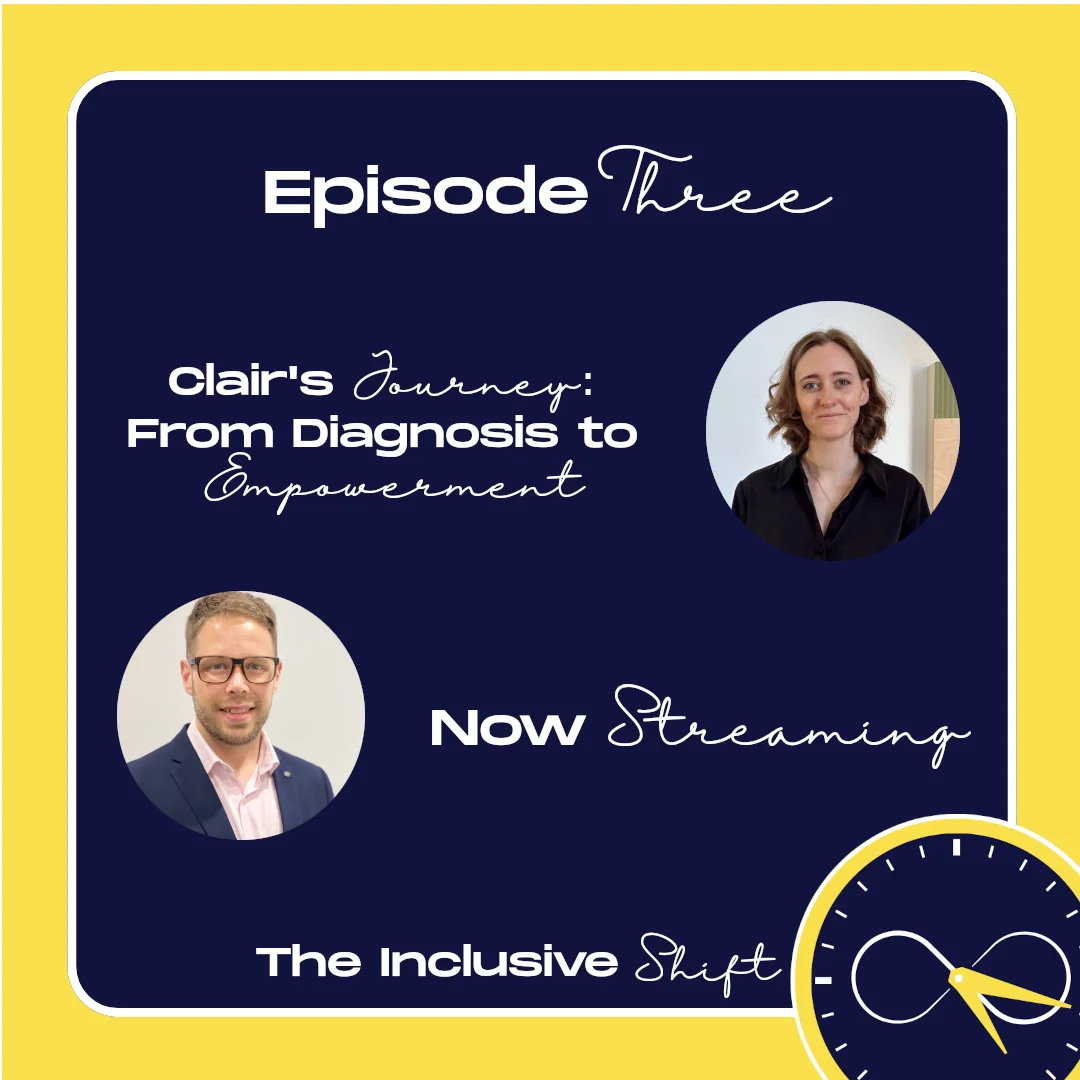
About this episode
Clair shares their journey of unmasking at work, the significance of clear communication, and the importance of ongoing dialogue between neurodivergent individuals and their colleagues.
Resources mentioned
- VIDEOFlexible work arrangementsFlexible work is becoming increasingly important for employers in attracting and retaining diverse and talented employees. A flexible work arrangement is an agreement between an employer and an employee to change the standard working arrangement to better accommodate an employee’s commitments outside of work.
- GUIDESetting your work hours and location in OutlookMicrosoft 365 can help you manage and share your work schedule. You're also able to specify more details about your work schedule, including where you're working (remotely or in the office) and whether you work different hours on different days.
Transcript
Nic (00:00)
Welcome to the inclusive shift, the podcast where we explore what it takes to build inclusive workplaces that embrace neurodiversity.
Continues for 30 min 43 sec — read the full transcript
My name is Nic Nagtzaam and in each episode I sit down with neurodivergent professionals, leaders, experts to hear their stories, challenges and insights on creating inclusive workplaces. My guest today is Clair, a supply chain and logistics professional with a passion for learning. Clair, welcome to the Inclusive Shift.
Clair (00:23)
Thanks for having me, Nic.
Nic (00:24)
Clair, before we dive into via your Neuro divergence and workplace experience, I'd love to get to know you outside of work. So who is Clair beyond logistics and supply chain?
Clair (00:34)
That's a great question. Outside of work,
Nic (00:36)
excellent.
Clair (00:37)
I am a hobby enthusiast. I have a list of hobbies that I want to start because I know I will not have time or commitment to begin all of them at the same time. Anything that I can learn, I will do. Last weekend, I took a short course in car mechanics. I have...
I'm very into woodworking and crochet. So anything that keeps my hands busy is a good one. But essentially, I just love to be involved in different things. Next month, I'm going to take up beekeeping. And so I basically just keep myself busy with waking my way through this list of hobbies that I would love to learn and haven't learned yet.
Nic (01:16)
That's awesome. Thank you for sharing a little bit more about yourself. Let's shift a little bit into your story of neurodivergence. You've talked to me about your ADHD and the possibility of being diagnosed with autism. What was that like to hear for you?
Clair (01:29)
pretty relieved I think when I got diagnosed with ADHD. I think that I probably should have been diagnosed a lot earlier than I was but after I went through a pretty major breakup I was not able to do basic things and I went and saw a therapist explaining I cannot unload the dishwasher. Things that normal or what I thought normal people could really do on their own I would rather
cry on the floor of the kitchen than do. So hearing that there was something that I could put a label on was really helpful. And hearing that my sensitivities to my environment are not necessarily just by choice, but also by design was really relieving for me because it meant that I could do something different and I had a reason for it.
Nic (02:15)
Hearing that must have been validating in some ways, right? So looking at it now with that lens, what do you see your past experiences as different? Do you see them differently?
Clair (02:28)
I do. I don't have a good memory from before I was about 16. Like I don't actually have many memories at all. And reflecting back, I think a lot of that is due to just simple overstimulation. We've moved a lot and that also creates a factor, but I grew up in a really fun but noisy household. And I think that that did really impact how I grew up.
And when I reflect back on the things that I struggled with as a kid, and then during high school and university, all those things could be explained by neurodiversity. And I was so good at masking. I'm a pro. I'm a pro masker. And that's something to be proud of, but also once you actually learn that it's such an effort to do, it's really hard to turn back on. So that's something that I've really struggled post diagnosis is just.
understanding that I am uncomfortable sometimes and to not be uncomfortable would be to unmask but or to make other people more comfortable is to mask and sometimes I don't want to and it's harder to do it now and I think a lot of my friends and family really recognize that I have changed but the reality is I don't feel different on the inside I just look different on the outside so that's been really a big adjustment for the people in my life I think.
Nic (03:46)
a little bit profound. Thank you for sharing. I'd love to bring it back to your work and the present day. In supply chain and logistics, what does a really good day look like for you?
Clair (03:57)
good question. I think in my current job, a really good day looks like if I could, if I could really design my day, I would spend half of the day looking at data and to, I'm a project manager in logistics and I love to make decisions based on data. And the company I work for right now doesn't always have the best data to work with, but that's kind of part of the fun to manipulate it in a way that is helpful. I would love to spend half of my day on that.
It's not possible because that's not actually my job, but I would say a good day. My current job would be probably 50 % meetings and 50 % actual productive time. And that is realistic. The meetings themselves, I would love to have maybe half of them with people that I am comfortable around, fully comfortable around, and I can unmask and that feels a lot less taxing. And maybe that's being in person. So I don't have to try and focus on.
people's faces as much in the video and then maybe half of the meetings online where all of our teams typically turn their cameras on. But sometimes I can do something underneath the screen and it's not as distracting as it would be in person.
Nic (05:03)
So what would make a day much harder for you then?
Clair (05:06)
I find days that are exclusively online. So I don't work from home much at all. Maybe on a Friday I will do working from home, but that's because I have no meetings on a Friday. A straight day of Teams meeting, I find exhausting. I really struggled to understand where people are at without the rest of their body to read. The face is quite hard.
And I find that I amplify my reactions to try to be more pleasant on the other receiving end. So I'm just constantly like amplifying how I'm trying to feel and show what I'm trying to feel. Whereas I don't find that I have to work that hard in person. So there's a mixture of, full teams meetings, but then also the dynamic of the people I'm meeting with can be a bit challenging sometimes too, based on my current role. So.
It kind of just depends on the flow of the relationship, but a difficult day would be a full day of teams meetings with stakeholders that I don't know very well or don't know me very well. I would find that really challenging. Yeah.
Nic (06:11)
No, team's fatigue is a real thing,
Clair (06:15)
Bye.
Nic (06:16)
And it happens to the best of us. I definitely don't enjoy being wall to wall, eight hours of team's meetings any day of the week. I need breaks from the screen.
Clair (06:26)
Absolutely,
yeah.
Nic (06:27)
So you've mentioned that clear communication is key for you, right? And asking lots of questions is a big part of how you work. How has that played a relationship with your colleagues and your manager?
Clair (06:38)
this got ups and downs. I know that, so if we talk about the questions first, I learned best when I can ask questions. And if someone is not feeling very patient or they don't have time to educate me based on what their role is, because sometimes I struggle to see the hierarchy as well. I will ask the CEO the same question as I would ask a peer.
And I know that that can be kind of confusing to receive. So if I am trying to learn something, going to ask questions. Typically, if I know that the session is for me to understand a particular system or process, I'll write it in the invite. I'll say, I'm going to ask a lot of questions. If this is falling on a day where you are busy and patients will be tested, we should move it. And I'm quite happy to move it. I would much rather move it and.
be confident that I have the freedom to ask questions versus not know which questions are irking the other person because that's also quite difficult. I don't necessarily pick up on if it is the quantity of questions or if it is the type of question that is creating the disconnect. So I just keep going. And if I pick up on the fact that they're a bit annoyed,
It means I'll just stop altogether. And then I've basically stopped taking in information in the same way. So it's a bit of a balancing act, but I try really hard to be upfront about it because I have had it received pretty poorly before. Unintentional. Like I didn't realize that not everyone asks as many questions as I do until maybe a couple of years ago. And when it comes to
clear communication and how that impacts my relationships at work. It can be tough. I don't function well in ambiguity. It is something that comes up on every single one of my development reviews since I can remember and I try really hard to practice. It's something that I have to actively work at every single time it comes up. If it's feeling a bit in the gray space, I work really hard to try and reflect on what's working.
and not just focus on it's grey. But if the expectations of me and my role are not clear, that creates a lot of doubt. And I do really like a direct dialogue. And I think what some people don't realize is when I'm trying to be direct in dialogue, some people will say, it's great that you're direct, it's very brave.
And they don't actually realize how excruciating it is to try and be vulnerable and say, I'm not understanding what you want from me. And they only see that I'm being direct and not like the angst that is underneath the direct communication. So it can be interpreted as a little bit intimidating because they don't know how to match it. And then also
Nic (09:25)
Hmm.
Clair (09:26)
it sort of creates an image that I'm really confident, but really I'm really confused.
Most of time, I'm really confused if I'm having to ask, what do you want from me? That is because I do not know what you want. And I think that that can be a bit misconstrued and interpreted in different ways. I have had some managers that are really great at it and a lot of them are. And sometimes it rows in the wrong way. And
We work through that in a different way. Maybe they send me something in writing first so that I can digest it and then we can talk about it. But really having these in writing is super helpful for me. I use OneNote. Like no one you've ever seen before, I can guarantee it. And that is because I will write what is said to make it clear for me. And then if it is still unclear, I will send it and say, this what we've agreed? So that clear communication.
is really necessary for me, but I do feel like in a lot of my dynamics at work and outside of work, I'm responsible for, it seems like 60 or 70 % of that clear communication because I'm having to reiterate multiple times to make sure I understand. And I'm trying to work on doing less of that and having people meet me 50-50.
Nic (10:42)
Sometimes it's not as easy as it looks. guess the looking at looking back just as well about what you were saying about being in the gray, guess sitting in the gray is a challenge, right? Because it elevates be it that level of anxiety or rejection sensitivity as well. Cause you're like, am I doing the wrong thing? it the right thing that I'm doing or like, I'm not sure. And having that be it elevated anxiety or stress is just not.
great for anybody. So I can
Clair (11:09)
No.
Nic (11:10)
completely appreciate having clarity before you step in to do a piece of work, right? It's important.
Clair (11:19)
Yeah. And
I think it does depend on the relationship that you have with your manager. My current relationship with my manager is probably the most transparent when it comes to neurodivergence that I've had so far. And we are able to talk about things like rejection sensitivity dysphoria and how that impacts how I am interpreting a situation. And if there's a series of events that have transpired, how I have digested that versus how they have digested that.
And it's really kind of fun and interesting to see the different interpretations of the same event. And I like being able to play that back with someone in real time and having that active feedback I can see why you thought that, but that is not what I meant.
Nic (12:00)
Yeah, mean, definitely having a manager that will allow you to have that back and forth and to see both sides is phenomenal. It's not something that is extremely common in the workplace. I'd love to see more of that coming up, that's for sure.
Clair (12:16)
Mm-hmm.
Nic (12:18)
Let's...
Let's jump through to another question. So, a be it, part of your story about unmasking at work, you've mentioned things like being able to crochet your desk or setting your own schedule, be it moving to a nine day fortnight or now shifting your different, to different operating hours as well. What does that shift meant for you?
Clair (12:37)
It's been astronomical. It's a real game changer. The crocheting at work happened in my previous role, specifically when I had to do a lot of eLearns. And they were all video based, which I appreciated, but I was constantly getting distracted by my own emails. It was ridiculous. So I brought the crochet into work and it was more of a test because I was on a really short contract.
And it was kind of like, what are they going to do with me if they don't like it? Like I'm here for six months. What could they possibly say? So I tested it and it was an overflow plan. And I learned that no one said anything. Like it never came up for multiple months until finally one of my coworkers said, what are you making? So like they were curious about what I was making, but they were never curious about why I was crocheting at my desk, which I found.
liberating. I thought, my god, people don't actually care about what I'm doing at my desk all the time. This is fantastic. So whenever I have a meeting that requires, doesn't require me to take notes, but does require me to focus, I will crochet and I will do it underneath the camera if they don't know that I'm doing it. I have, during COVID, I absolutely cracked where the camera is and was able to work out how to keep everything underneath the screen. That was amazing as well.
But when it comes to my work hours, when I took my current role, I requested 9.30 to 5.30 and I thought that was significant enough. I did that for about a year and a half and I loved it. but then I was finding that I would stay back late. So my productive hours are between two and six, maybe two and seven. And that's when I'm really getting into that.
super hyper-focused mode, depending on what I'm working on. God forbid I'm in Excel at that time of day, because I will never leave my desk. But if I'm in a good zone, it's between two and seven. And so I would be starting at 9:30, but I wouldn't be leaving until 6, 6:30. And there's no time for anything outside of work if you're trying to do that. So I shifted it to 10 till six. And 30 minutes makes such an astronomical difference in my day.
Because I can wake up, I either wake up slowly, which I love, so I can make myself pancakes on a Wednesday just because, or I can go to, I can go for a run or go to the post office or basically do any of the life admin that I wouldn't have time for if I was getting home at seven or 7 30. And it really bridges that gap. Otherwise you just lose time.
Nic (15:05)
How do you wish that workplaces would adapt to a new kind of flexibility for employees?
Clair (15:13)
I think the work hours is a big one. We're really close. I think we're really close to being pretty inclusive. I'm really fortunate in my current workplace that they make it pretty easy. It's in the EA agreement. So if you have an adjusted schedule, it's pretty simple to do. Outlook also makes it so easy to put in your working hours in your calendar so that everybody can see them. But...
I don't feel like there's enough discussion about what hours actually work for people. Like I've come and said, this is when I'm productive, but I don't think that that conversation actually happens amongst groups normally of when they actually are having productive times. I think that sometimes it comes up in team building sessions with maybe an external consultant and they come in and they say, talk about how you want to work. And they sort of create a system for teams on how to communicate with each person and what works for each person.
But aside from that, the overwhelming assumption when you set a job is that you'll work nine to five. And I think it could just be a question at the beginning, like what hours work for you? And when I say that, I don't mean specific to families. Like I don't have dependents. I don't have a, I don't have a partner. So those hours are what worked for me, but I do feel like if I had kids and that came up in the interview.
Then they would be more inclined to ask me about what hours work for me based on what time I dropped them off or what time, like how old they are. But as an individual contributor, that never comes up unless you ask for something. And then that feels like you're asking for an accommodation, but really it doesn't impact my team whatsoever. So I think talking about it more would be helpful. And then also just like bringing it up more than one time because everyone changes throughout.
their working period. What works for me now might not work for me in three years time, but it creates a lot of dependence on me communicating to someone and asking for something versus just presenting what the options are.
Nic (17:09)
That definitely makes a lot more sense.
I think it's probably as well the making sure that both parties within the relationship, be it the manager and the employee feel, be it safe enough to have that conversation as well or to bring it up to go, hey, are your hours working for you or what else is going on in your life? Is there something that we can support you in?
Clair (17:31)
Mm.
Nic (17:31)
And not every manager is going to sit and have that conversation. I don't think everyone would feel Psychologically
safe enough to have that conversation at all all the time but it's definitely something I'd love to see more of.
Clair (17:45)
Yeah.
And I actually would also like to clarify that when I say these things about working hours, I'm making a general assumption about who's listening to this recording because when I'm working in warehouses that I'm on a shift work and I'm managing a shift, I don't have the option to choose those hours. I have to show up at the beginning of the shift and I have to leave at the end of the shift. So it really depends on what role that you have. But I do think that there can be more discussion even in shift work.
about when breaks should be. I don't want to be told that my break is at 12 because I might not get hungry at 12 and that might impact the rest of my flow. So I do think that there's a bit of opportunity for flexibility in those types of environments also. I do understand that in a warehouse environment, for example, you have to have an efficient flow of who's taking breaks when so that you're adequately staffed the whole time.
But it would be great if there were more systems that existed for rostering or for inserting your preferences if you are a shift worker so that you can really design how your day can work for you. And I think that might actually help with a lot of like team retention because you're not forcing someone to literally just be in a box the whole day and take their 15, their 30 and their 15 exactly when you tell them to. I don't know that works for everybody.
Nic (19:03)
I love that concept though, right? So having a system that you could go in and submit your preferences to and it then gives you, you know, or the manager, an efficient roster to go, hey, shift these people into these schedules and you're going to get a better flow throughout the entire warehouse. I that's something that I don't think I've ever seen before.
Clair (19:26)
that actually exists yet. I think that labor management systems could be getting closer. The best that we've got is it'll attract when people clock in and clock out and it'll design the roster for you. But you would have to have a pretty substantial system that would tell you if people are abusing their breaks, you don't have the visual cue of seeing everyone come back at the same time. So if you're managing a group of people, it could be a bit difficult. But
If you are transparent with your team and your team is transparent with you and they respect you and they're not going to abuse you and what you're offering, I think it could benefit everyone because they're going to be a lot happier coming to work.
Nic (20:01)
Absolutely. So if you could say one thing to be leaders or co-workers that are working alongside neurodivergent people, what would it be?
Clair (20:11)
I this question because I feel like a lot of people ask me this question and I think that they are looking for a puzzle piece to a puzzle that doesn't exist. And everybody just wants one response to this. This probably will work for everyone. If you do this one thing that you'll be a pretty good manager. But the reality is that like neurotypical or neurodivergent, we are all so different. And
The reliance on me to be able to learn about myself and then proactively approach my team and proactively approach my manager with the things I'm learning about myself of what work and doesn't work. It's a heavy reliance on me doing that. So when you start a job or you start, you start the conversation with your manager or team about being neurodivergent or not.
That initial conversation is typically as far as it ever goes. It's not really revisited. It's like, okay, well, Clair told me that they work best from two till seven. Great. But in three years time, I might wake up and for whatever reason, I've decided I'm to be a morning person. And I Shift that. I then need to be able to communicate that to everybody else. And I think something that would really help in these conversations is that.
The dialogue doesn't end the first time you have the conversation. It's not a tick and flick. And also, I don't think that I personally, I will just speak for myself. I will not be offended if you would like to clarify later. I will not be offended if somebody said, does this still work for you or do you want to mix it up a little bit? Because that would make me feel more encouraged to continue to learn and try new things that work for me.
Because maybe I haven't cracked the code of how to be the absolute most productive.
Nic (21:53)
Awesome. Well, I absolutely agree, right? So if you've met one neurodivergent person or neurotypical person, you've met one neurodivergent person or neurotypical person. We're
Clair (22:04)
Mm-hmm.
Nic (22:05)
not a puzzle piece. We do not fit a mold. We are all unique and we should all be treated uniquely. And I guess that comes down to being in a management position.
Having a conversation with each of your team individually to better understand them as well is absolutely key because you need to be able to adjust to the way that you support them for them, not for the whole team. So, completely agree.
Clair (22:30)
Yeah. And like how many
times have you heard people say something about growth mindset? Companies are always, they're always preaching growth mindset, but the dialogue doesn't really support growth mindset if we're not encouraging ourselves to try different things with our routine and our structure. We're still showing up nine till five every single day and having lunch at 12 and doing the same thing all the time. We might be having a growth mindset in
our thinking is in a meeting, but we're not really challenging ourselves to think, is this the best I can do? Is this the thing that works best
Nic (23:01)
Hmm.
Clair (23:02)
for me every day?
Nic (23:03)
Absolutely.
Clair (23:03)
Mm.
Nic (23:05)
So turning the tables then, I'd to give the mic to my guests towards the end. Is there a question that you have for me?
Clair (23:11)
You have done a lot of research in Neuro Divergence, and I would say that you are a pretty strong advocate on LinkedIn and social media and you started this podcast. And at work, are one of the strongest voices when it comes to workplace inclusion. How have you changed your language when it comes to
how you talk to people or how you communicate to other people as you learn about Neuro divergence
Nic (23:37)
It's definitely growing every single day as I learn more and more and more.
For me, it's taking a moment to better understand the individual. So if I know that I'm sitting down with someone that is neurodivergent or that is a neurodivergent, I'll try and adjust the way that I'm having a conversation with that person, depending on how they like to communicate with me.
if I don't know, but you know, I've made assumptions, then I probably shouldn't be making assumptions because that's just the wrong thing. But I try to ensure that I adapt to the conversation that I'm having at the time. So if someone is speaking much slower, then I'll try and slow down my pace as well so that I try and meet their tone level. If someone is speaking super fast and we're having a high energy conversation,
I typically sit there and have a high energy conversation with that individual. And most other people are sitting on the side going, what are they talking about? Because you're talking a hundred miles an hour. But I think it's really just for me, or at least from my perspective, it's...
How does that person best work and how can I best support them, be it in the way that I'm speaking to them or in the way that I am engaging in the conversation with them as well.
Clair (24:50)
Yep, this is a ringer question, but listening to your answer, you're really good at reading people. So do you have a suggestion for people who might be not as skilled as reading others on how to adjust their language to be more inclusive?
Nic (25:07)
That's a challenge It's definitely more of a challenge when you're when you're on a virtual conference, right? And
Clair (25:12)
Mm.
Nic (25:13)
you mentioned it before you don't get to see anything be it below here
Clair (25:17)
Yes.
Nic (25:18)
Which means I don't know what I'm doing my hands. I don't know if I do my feet and That that body language is is a huge part that plays that that plays with that right? So it's
trying to ensure that you can at least understand facial cues if you can't understand facial cues and it doesn't always work right so i could make an assumption that someone is happy and they're absolutely pissed off in the background
Clair (25:42)
Yeah.
Nic (25:42)
and it happens
But it's, you know, if I see tension in a room, I try and make, you know, light of something to try and cut through the tension, just to try and reduce that and make sure that everyone is comfortable at the same time.
Clair (25:59)
Yeah, that is fair. I find myself, if I'm really not clear on how I'm interpreting someone, because I am so direct, will point blank ask them, am I being too direct? Do want me to be a bit warmer? Do you want me to like have a bit of a softer approach? And honestly, 50 % of the time they say yes. They're like, yeah,
Nic (26:17)
Ha ha ha.
Clair (26:18)
can you try a little bit and be a little bit warmer? I'm like, absolutely. I take that on board.
But yeah, you're right. It's, if you can pick up on the tone and tone is a good one. If you can pick up on a tone and the speed of how someone's talking, it's a really simple way to just show that you can meet them at their level of however they want to be approached. And I think that would be really well received. Yeah.
Nic (26:44)
Yeah, and it doesn't always go down easily,
Clair (26:48)
Mm.
Nic (26:48)
but at the same time, you know, it's... all you can do is try your best.
Clair (26:52)
It also creates a lot of work
for you.
Nic (26:54)
It does. I mean, I would much rather be very similar to you, just flat out direct and blunt, because that's just the way that I like to work. But
Clair (27:02)
Mmm.
Nic (27:03)
I've been coached by many people, more senior to me in many organizations that say that I'm burning my brand by doing so. So I'm conscious of that most of the time when I'm having a conversation. If I'm comfortable with the person, then I'll be blunt and
Clair (27:21)
Yeah.
Nic (27:21)
tell them
how it is but if I'm not comfortable I typically tow the line and adjust the way that I speak.
Clair (27:28)
Can I take us on a quick side quest?
Nic (27:30)
Yes.
Clair (27:31)
When I was working in a warehouse, maybe about four years ago, we had a shift changeover. So I would do half of the week and my coworker would do the other half of the week and we would cross over on a Wednesday. And we were both very direct and often misunderstood each other. And I was a little bit more sensitive than they were as well. So often I would leave those thinking, I hated that conversation. That was terrible.
And when I talked to them about it, I was like, I think this is what's happening. I think that we're both very direct and I'm internalizing it and you are able to move on and I have not moved on and it's compiling. And I said, can we have a code word? And they were like, sure. So we had a code word and it was blueberry. And anytime we were in a discussion and someone said blueberry, it was a, we're parking it. We separate, we come back five minutes later. And like, that was the agreement.
And it made us such a more effective pair in that situation and in our entire working together. And it also made me respect them so much that we could just call it, park it, and then come back five minutes later. having that one, it's just a few minutes to have a breather made a really big difference. And I loved that neither of us really had to change our delivery.
It was a really lucky situation that we both were able to still
Nic (28:42)
Mmm.
Clair (28:43)
be completely direct the whole time. But then if we were getting a little bit, taking it personally, because we could walk away and come back. And then I didn't have to think about like how I was saying something because I trusted that they would tell me it's too much. Yeah, it was good.
Nic (28:56)
I love that. I've never used that before but I really like it. There's been many situations where I've worked with people that are just as blunt as I am and we clash and we clash for months but then
Clair (29:06)
Yes. Yes.
Nic (29:09)
once we understand how each other work then we really love to work with each other because we just want to get the same stuff done and we're extremely passionate about it.
Clair (29:18)
Mm-hmm.
Nic (29:18)
But having that co-word to kind of just go, let's just take a pause and we'll come back in 15 minutes when we're both a little bit calmer, that's awesome.
Clair (29:28)
Yeah, it was
really good. Would recommend.
Nic (29:31)
So before we wrap then tonight, is there anything that you would love to share with our listeners before we leave?
Clair (29:37)
I think the thing that I would like to share is that everyone is different, but there are so many jobs and so many industries out there that can work for each person. So I started in marketing, which is all qualitative, no quantitative, it's fluff, it's gray. You're constantly sort of justifying what you're doing.
based on what you think is the correct thing to do. It's a lot of emotional decision-making. Didn't work for me. Supply chain and logistics is all numbers. It's all qualitative. You can, or quantitative. is, you can make a decision and if you make one route more effective or efficient, you cut out 120K, just done. And I love that. And it makes me feel like I add value. And I think the one message is,
If what you're doing doesn't feel like a good fit, do some research to find what is a good fit because there's so many roles out there that could be better and you'll enjoy it lot more and you won't have to work as hard just to show up.
Nic (30:40)
Clair, thank you very much for coming on.
Clair (30:43)
Thanks, Nic